| What you see | Likely cause | Usual fix |
|---|---|---|
| Water running across the lawn or patio during rain | Surface runoff, poor slope | Catch basin, channel drain or regrading |
| Ground stays soggy days after the rain stops | Water trapped in clay soil | French drain |
| Puddles at the corners of the house | Downspouts dumping at the foundation | Underground downspout line |
| One wet strip that follows a buried pipe | Cracked or separated drain line | Leak detection, then pipe repair |
| Wall leaning, stained or wet at the base | Water pressure behind the wall | Retaining wall drainage |
Before trenching, we also check the irrigation. A stuck valve or a controller still on a summer schedule can look exactly like a drainage problem. See irrigation if you suspect that.
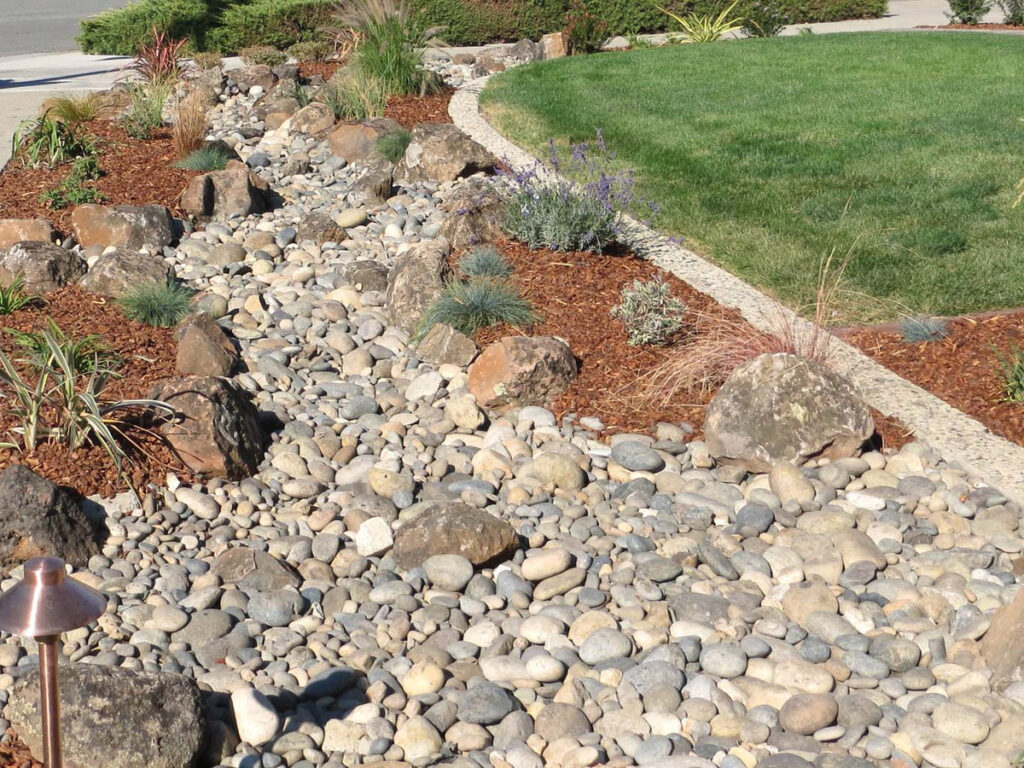
Most drainage trouble here starts in the soil. Much of the valley sits on clay that takes water in slowly and lets it go slowly, so a low spot that floods in December can still be soft in February. Water that sits against a footing or behind a wall is the part that costs money later. The fix is to collect it, move it by gravity and send it somewhere it can leave.
Our San Jose drainage services include
- French drains: a gravel trench with perforated pipe that collects water moving through saturated soil and carries it to an outlet.
- Drain pipe leak detection: we find where a buried yard drain line is cracked, separated or full of roots before anyone digs.
- Downspout drains: buried lines that take roof water away from the foundation, plus clearing lines that have clogged.
- Catch basins and channel drains: surface inlets at low spots, patio edges and driveway aprons that take water underground.
- Dry wells: an underground holding point for runoff on lots with no gravity outlet.
- Yard grading: reshaping the ground so water runs away from the house instead of toward it.
- Drain pipe repair: replacing broken, crushed or sagging sections of yard drain line.
- Retaining wall drainage: gravel, fabric and a footing drain behind a wall so water pressure does not push it over.
When drainage work needs a San Jose permit
Most yard drainage work in San Jose needs no permit. The City of San Jose requires a building permit for a retaining wall taller than 2 feet from existing grade, and a Public Works grading permit for a wall that carries a surcharge or measures 4 feet or more from the bottom of the footing (City of San Jose, fences and retaining walls). Work that changes drainage onto a neighbor's property or ties into the city storm drain can also need approval. We flag any permit in the written proposal.
Why homeowners hire JPM for drainage
Drainage is rarely a stand-alone job for us. It is part of the design-build work JPM has done in San Jose and Santa Clara County for more than 30 years, so lines are planned around the finished yard. JPM holds a 4.9-star rating from 93 reviews on Houzz and 12 Best of Houzz awards (2014 to 2025).
Get your yard dry before the next storm
Most of San Jose's rain falls between November and March, so the best time to fix drainage is before the next storm. Call (408) 636-6442 or request a free estimate. You get a written plan and price before work starts.